GarganText platform
GarganText Platform
 GarganText is, an open-source, decentralized, collaborative web platform for knowledge exploration developed by the CNRS' French Institute for Complex Systems Paris île-de-France (ISC-PIF).
This software combines tools for natural language processing, text mining, complex network analysis, and interactive data visualization to enable new types of interaction with digital corpora.
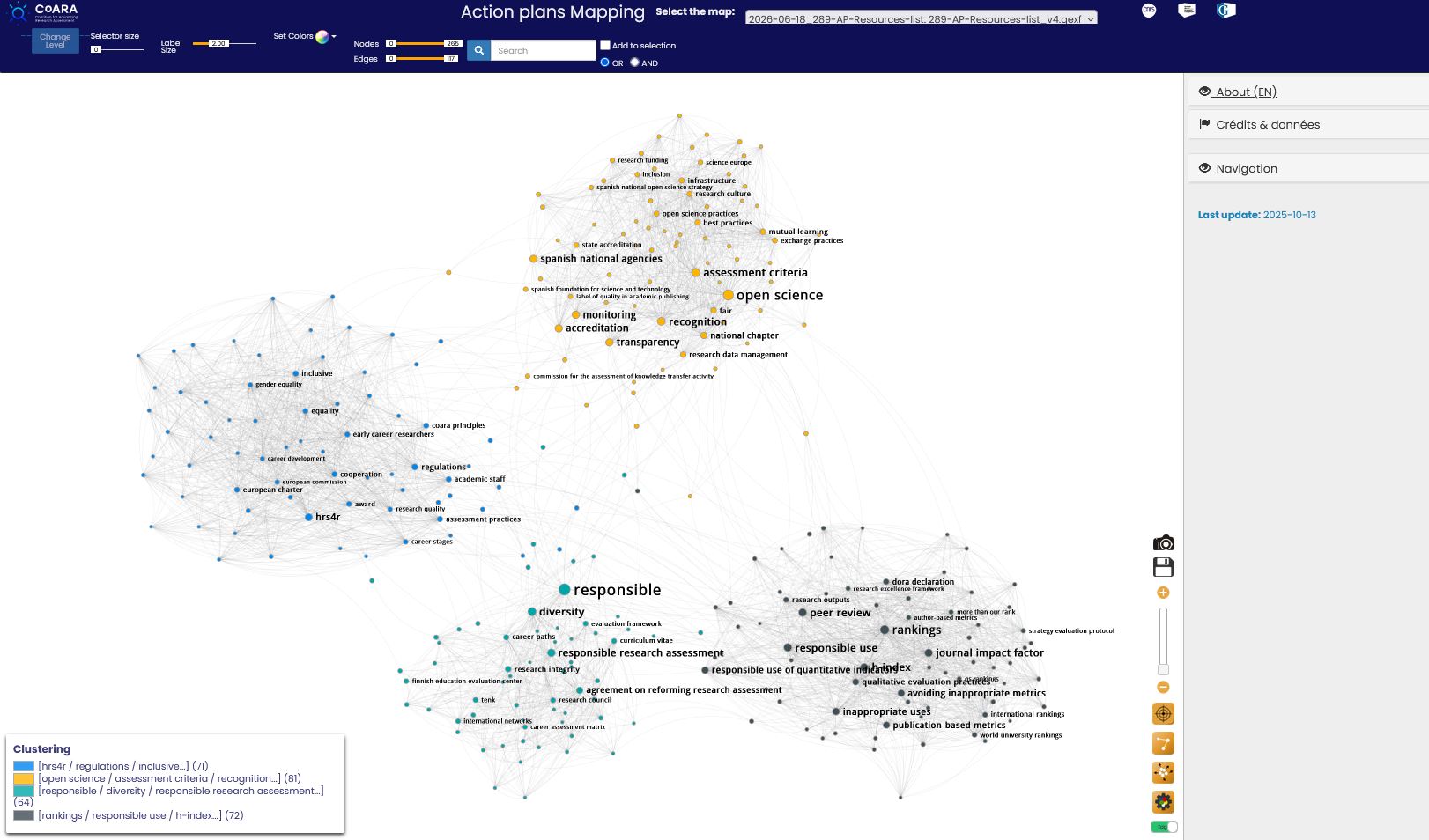
Based on the data extracted of the action plans (texts), GarganText calculates the occurrence and proximity of concepts across all the provided data, and establishes clusters distribution of the concepts addressed in this corpus.
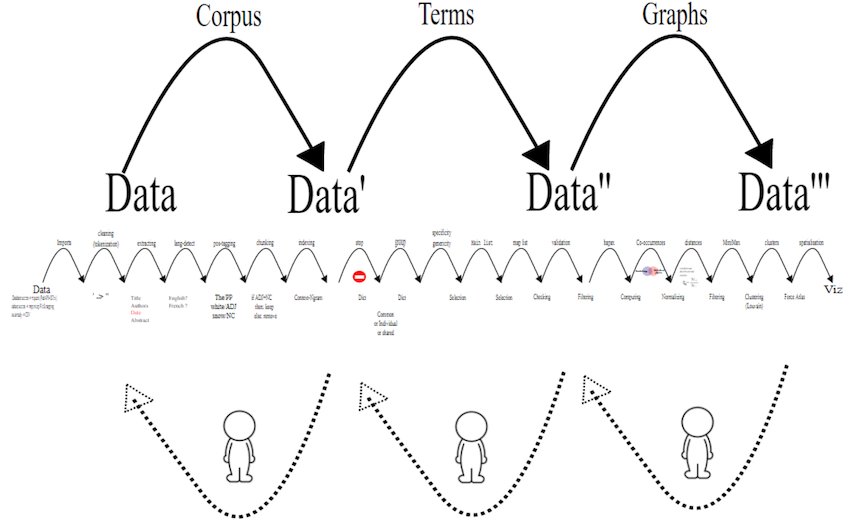
GarganText provides a secure collaborative workspace with AI-based visualisation and optimisation tools (e.g. detection of Key Concepts in free text). GarganText visualises the key concepts of the corpora loaded (or written or imported via API or files). In the case of CoARA, the TSV file is imported from the HTML. To provide the word mapping, GarganText combines automatic language processing, data mining, analysis tools, complex graphs and dynamic, interactive visualisation of textual data.
GarganText is designed to produce living maps that evolve as you work with them. The maps can be used for dressing a state-of-the-art, mapping multiple documents, setting up a collective representation of a problem, etc. The map is not the ultimate goal, rather, the main resource is rather, the back and forth between the different levels of the corpora (document, terms, maps) that helps to build an adaptive representation of a question.
Knowledge discovery with GarganText sofware
A collaborative web platform that combines tools for natural language processing, text mining, complex network analysis and interactive data visualisation to open up new types of interaction with your digital corpora.
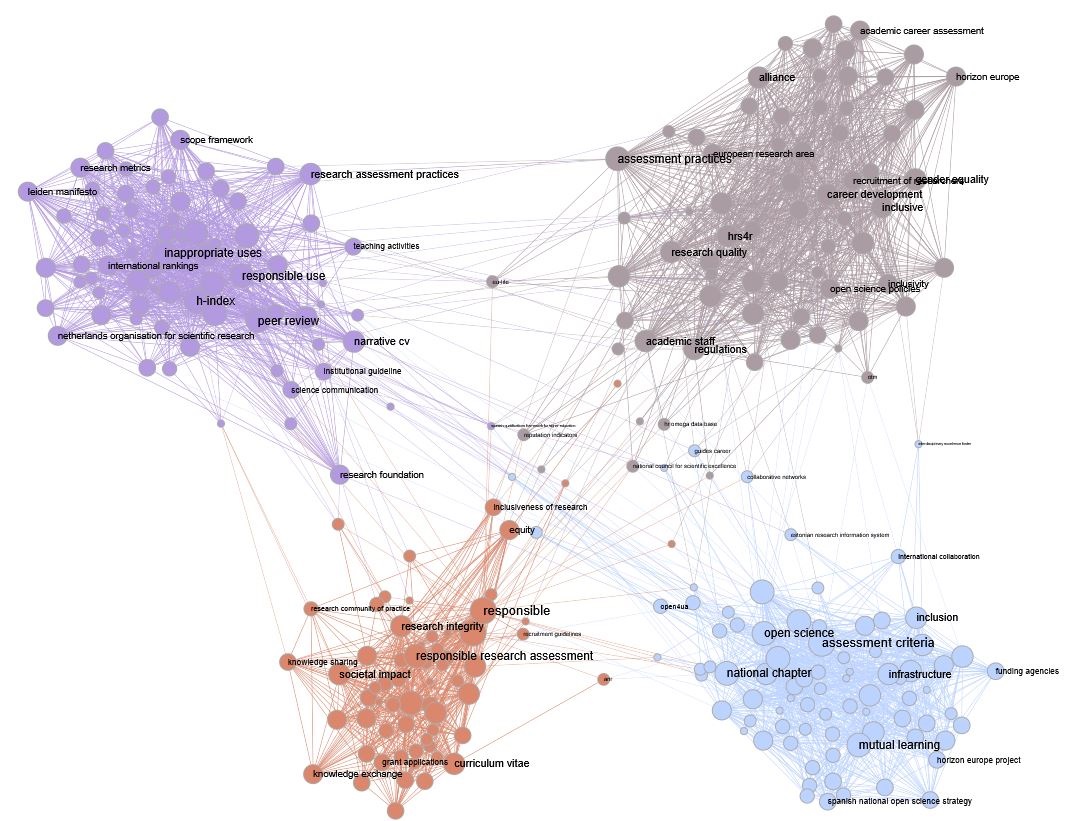
Global map from Zenodo
In the map view, users can access to a high level and synthetic view of the corpora in the form of a graph. The nodes of the graph are the terms that are considered as relevant for the topic. Links are proximities between these terms as inferred from the analysis of the whole corpora. Two different measures of proximity are currently implemented:
- The conditional proximity. This is simply the probability of having term B in a document knowing that it already contains term A. This distance will give you the landscape of interactions between terms in your corpora. It is best suited for large enough corpora (>500).
- The distributional proximity. This proximity measure compares, for two terms A and B the similarity of their co-occurrence profiles with all the other terms of the maps. This is not an indication of interaction (two terms can be linked without occurring even once together in the corpora) but it assesses a kind of structural equivalence. For example, synonyms will have a high probability to be linked.
Visualisation engine
The visualisation engine has an algorithm that maximises the information conveyed by a map by positioning the nodes that are strongly related close on the map. The spatialisation button makes it possible to run this algorithm when a user loads the map or when a user filters some edges/nodes. Click to launch the algorithm and click again to stop it. Links and labels are not displayed during repositioning of nodes.
At the end of the repositioning, nodes with the same colour should be close on the map.
Gargantext does not aim to have the last word on what a good map of knowledge is. It is designed to give the user, at every moment and at every level of granularity, the possibility to contribute to the delineation of the topic to be mapped. Thus, the knowledge maps proposed in GarganText should be thought as a particular representation of a body of knowledge that is co-constructed between GarganText and the user(s).
Maps issued from GarganText
In order to facilitate access to GarganText maps issued, you will find a interactive map that replicates the graph provided by GarganText.