
WG Responsible Metrics and Indicators (RMI)
WG Responsible Metrics and Indicators (RMI)
WG Objectives
The WG has three objectives, tackled in three stages (Oct. 23 – Sept. 25):
-
- Assessing the status quo: Which indicators are currently employed?
We investigate this across varied disciplines and cultural contexts, specifically in the evaluation of researchers, awards, institutional assessments, and the progression of scientific advancement (like tenure, PhD, habilitation, professor titles, etc.). Starting with CoARA members, institutions are asked to provide information on their current usage of indicators via a structured survey. - Critical evaluation of the indicators and recommendations. Based on the survey results, we develop guiding questions and recommendations (2a) when to use indicators (and when not),and (2b) how to integrate their usage with qualitative modes of assessment. This could be a decision path diagram, and will not be a “one size fits all” recommendation.
- Strategic plan for dissemination of recommendations. Share findings, strategies, and recommendations with a wider audience, emphasizing their applicability across disciplines and cultures.
- Assessing the status quo: Which indicators are currently employed?
Activities
Updated 25 May 2025
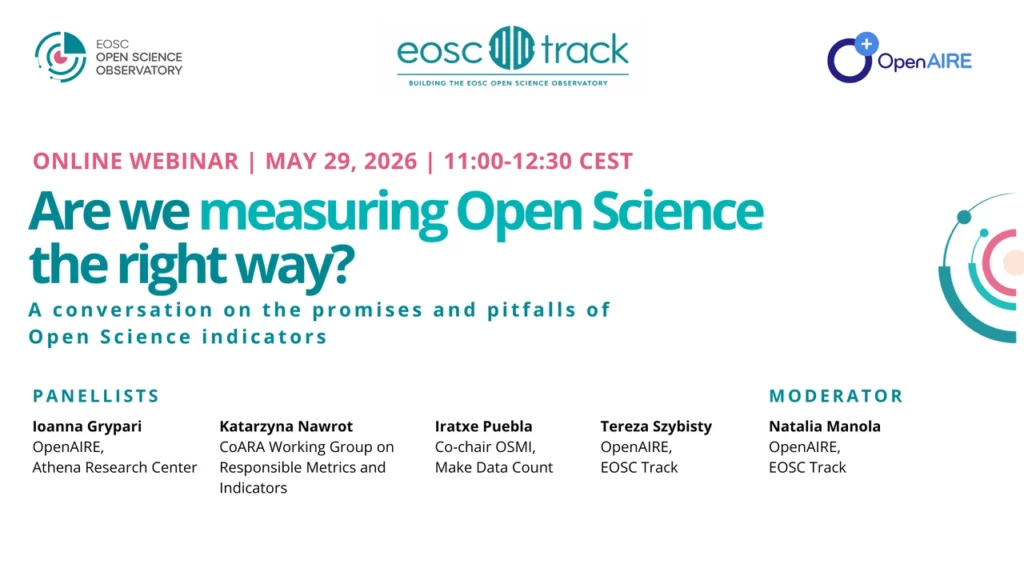
Webinar: Are we measuring Open Science the right way?
On 29 May 2026 at 11h-12h30 CEST, the WG RMI participated in a webinar on the promises and pitfalls of Open Science indicators. The webinar explores how Open Science indicators can be used responsibly to support evidence-based policy, monitoring, and research assessment reform. As indicators increasingly shape how progress in Open Science is measured and communicated, they also influence incentives across the research system.
The session brings together European initiatives working on Open Science monitoring, responsible metrics, and impact assessment to reflect on the opportunities, risks, and guiding principles for the use of indicators in policy and practice.
The discussion aims to recognise that indicators do more than describe reality - they can shape incentives, influence behaviour, and affect policy and funding decisions. The session will create a space for dialogue between monitoring initiatives, research assessment reform efforts, and policy actors working to ensure the responsible use of indicators in the European research landscape.
Affiliated Organisations
- German Psychological Society (Germany)
- Leibniz Association: IWM Institut für Wissensmedien (Germany)
- Leibniz Association: Leibniz Institute for Psychology, ZPID (Germany)
- BIH / Charité Berlin (Germany)
- Berlin University Alliance (Germany)
- Alexander von Humboldt Foundation (Germany)
- Swiss Reproducibility Network (Switzerland)
- EPFL – Swiss Federal Institute of Technology in Lausanne (Switzerland)
- Italian Reproducibility Network (Italy)
- Università di Pisa (Italy)
- Roma Tre University, Department of Science (Italy)
- Italian Institute of Technology (Italy)
- IMT School for Advanced Studies Lucca (Italy)
- University of Ferrara (Italy)
- Università degli Studi di Milano (Italy)
- University of Messina (Italy)
- Aix-Marseille University (France)
- Université Paris Cité (France)
- Université Côte d’Azur (France)
- Université Lumière Lyon 2 (France)
- University of Luxembourg (Luxembourg)
- Swedish Reproducibility Network (Sweden)
- Karlstad University (Sweden)
- Tbilisi Medical Academy (Georgia)
- Sociedad Científica de Bibliometría y Cienciometria (Peru)
- CERN – European organisation for Nuclear Research (Europe)
- UAS4EUROPE – Universities of Applied Sciences for Europe (Europe)
- OpenAIRE AMKE (Europe)
- International Consortium of Research Staff Associations (Global)
- Molde University College (Norway)
- Poznan University of Economics and Business (Poland)
- University of Cyprus (Cyprus)
- Vrije Universiteit Brussel (Belgium)
- Hungarian Academy of Sciences (Hungary)
- Masaryk University (Czechia)
- Finnish Learned Societies (Finland)
- BOKU University (Austria)
- University of Monterrey (Mexico)
- CRG – Centre for Genomic Regulation (Spain)
- AQuAs – Agency for Health Quality and Assessment of Catalonia (Spain)
- Young Academy of Slovenia (Slovenia)
Find Out More
Want to become a member of the RMI WG?
- Members of the WG are CoARA members (i.e., institutions), represented by a concrete person.
- Experts of the WG are individual persons who are experts in the field, but are not officially representing a CoARA member. The WG can (proactively) contact them for consultation.
- Friends of the WG are generally interested persons who want to simply stay informed.
Click the button below to access our Github where you can find all contacts and instructions on how to join or contribute to the Working Group.
Join the Working Group!
Interested in joining the Working Group?
Do you have any questions?
Please contact:
Felix Schönbrodt
Ludwig-Maximilians-Universität München
Rachel Heyard
University of Zurich (UZH)
Davide Crepaldi
SISSA
Katarzyna Nawrot
University of Warsaw