
From Principles to Practice: An Interview with former Vice-Chair, Dr. Elizabeth Gadd, on the evolution of CoARA and next steps for reform
From Principles to Practice: An Interview with former Vice-Chair, Dr. Elizabeth Gadd on the evolution of CoARA and next steps for reform
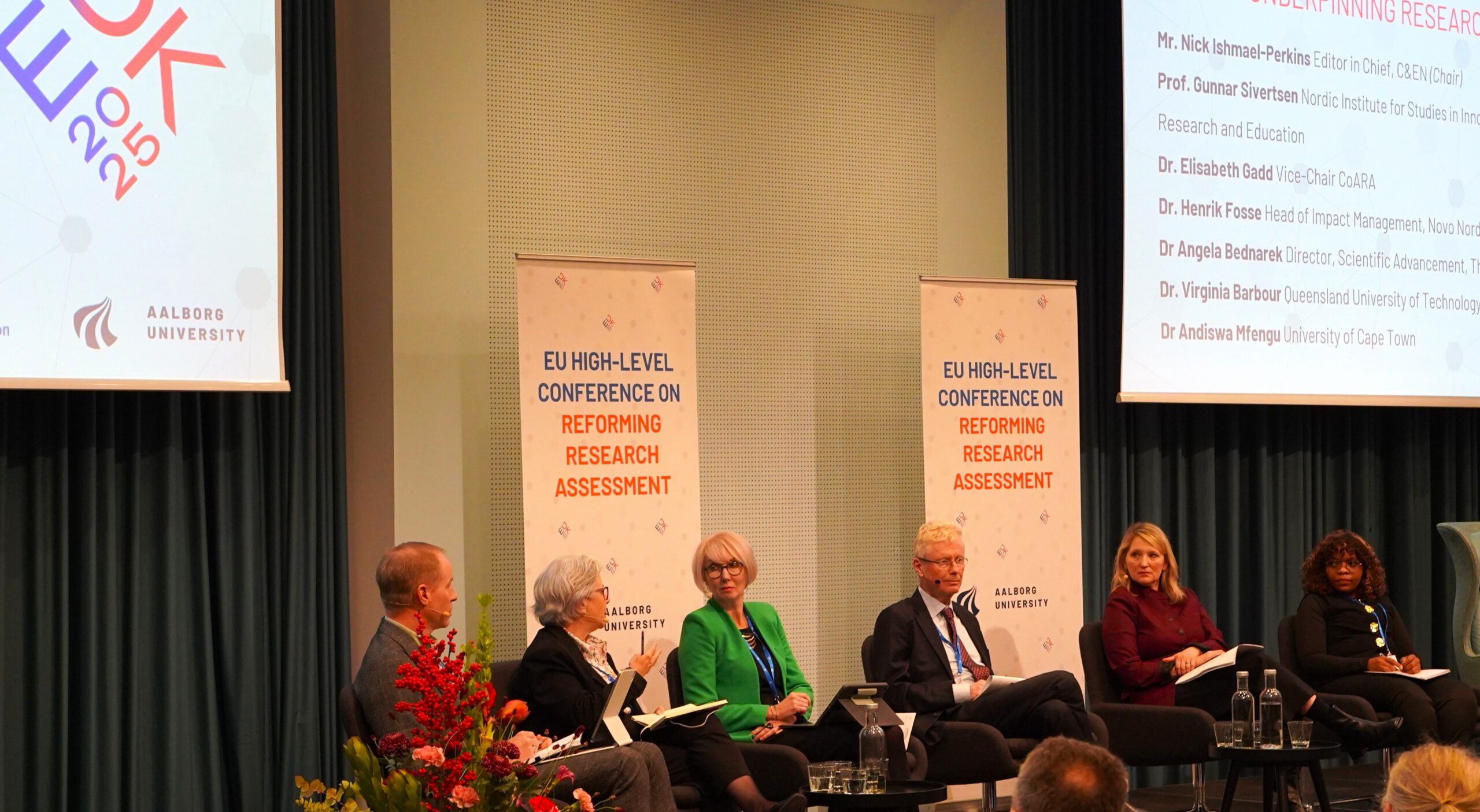
As we celebrated the 3rd anniversary of CoARA in December 2025 in Copenhagen, this milestone also marked a moment of transition for the coalition. CoARA welcomed two new members to the Steering Board and elected Janne Pölönen as the new Vice Chair.
Reflecting on this moment of transition, we look back at the foundational role played by Dr. Elizabeth Gadd, former Vice Chair of CoARA, whose leadership, insight, and dedication have helped shape the CoARA’s vision and community-driven ethos over the past three years.
Lizzie is a leading international voice on responsible research assessment and currently serves as Chair of the International Network of Research Management Societies (INORMS). As she steps back from her Vice Chair role, she shares reflections on CoARA’s formative years and the evolution of research assessment reform. In this interview feature, Lizzie also discusses her continued involvement in the coalition, stepping into her new role as Co-Chair for the CoARA Working Group Thinking Critically about University Rankings Network (WG TURN), and the principles she hopes will to guide the coalition for the years to come.
What inspires you about CoARA and its mission?
“There’s so much to love about CoARA but I think what I love about it most is that it’s a Coalition. It’s a group of ordinary people who might not agree on everything, but agree on two important things: firstly, that research assessment needs reforming, and secondly, that the way it’s going to be reformed is through collective action and mutual learning. There are many other wonderful initiatives in the assessment reform space, but CoARA is the only one that has prioritised the importance of community in delivering on reform.
This doesn’t always make for an easy ride. Humans can be utterly marvellous and utterly infuriating, but, as Atul Gawande once said, ‘we often long for streamlined technological solutions, but at the end of the day, people talking to people is how norms and standards change’.
CoARA has made a way for people to talk to people. No one has all the answers, but together we can share our intelligence, our expertise, and our learnings.”
Throughout your career, you’ve advocated for the responsible use of metrics rather than abandoning them entirely. What does that balance look like in practice?
“I always say that narratives without evidence can quickly become fiction but metrics without narrative only tell half the story. We need both to get to our best assessment of research, always bearing in mind that there is no such thing as a perfect assessment. We must continuously test the outcomes and impacts of new forms of assessment and recognise limitations if we are to make better decisions based on them.”
What motivated you to take on the leadership role of Vice Chair in the CoARA Steering Board during its foundational period?
“The main thing that drew me to put my name forward for the CoARA Steering Board was the fact that CoARA was the first responsible research assessment (RRA) organisation that explicitly acknowledged in one of its four core commitments the need to address the cascade effects of global university rankings.
This is something I’d been working on under the auspices of the INORMS Research Evaluation Group for about five years before I joined CoARA. I felt my experience could help the Coalition navigate this challenging space. It was a great joy in my final year to see the birth of the Working Group Thinking Critically about University Rankings Network (WG TURN). As the INORMS REG is one of the organisations co-chairing this WG, I very much intend to stay connected to CoARA’s work through this group.”
Recently, there’s been more momentum growing in the conversation for institutions to rethink their relationship to rankings. What practical steps can institutions take to break free from narrow assessment practices and ranking pressures?
“Many feel a sense of helplessness as to what can realistically be done to expose the limitations of rankings and break free of them. This is why the INORMS Research Evaluation Group developed the More Than Our Rank initiative which sits in the new CoARA Collection. This doesn’t demand that universities boycott the rankings, although some Signatories have. Indeed, an institution can even be proud of its rank but still acknowledge their limitations. If enough institutions do so, it will put pressure on the rankings to reconsider whether and how they assess institutions on the international stage.”
As the has coalition grown and continues to evolve, what’s been most rewarding to witness during this time?
It has, of course, been rewarding to see the impacts the coalition has already had on assessment criteria, influences on policy, and scholarly discourse. However, one of the most rewarding things for me has been the honesty, humility, and hard work of all the volunteers putting themselves forward to work on the important topics that make for a reformed research assessment environment. Meeting with these wonderful humans, promoting and supporting their work has been such a privilege! I take my hat off to each and every one of them.
A special highlight has been the connection formed with my fellow Vice Chair Karen Stroobants. We started at a place of mutual professional admiration and, by the end of the three years working side by side as Vice Chairs, have now developed a lasting bond of friendship.
As you step back from the Vice Chair role, what do you most want the CoARA community to carry forward?
“The C of CoARA stands for coalition, and the General Assembly is the highest decision-making body. While I’m stepping down from the Vice Chair role, I still remain a part of the CoARA community, representing both INORMS and Loughborough University. In these roles I’ll remain involved as a Co-Chair for WG TURN and through my contributions to the CoARA U.K. National Chapter.
I’m really looking forward to seeing the outcomes of the WG TURN and greater alignment between the big RRA initiatives in this space. The developments around the proposed ERA Act are also very exciting and present a significant opportunity to further embed RRA as an underpinning principle of any thriving research ecosystem.
I’m certainly not leaving colleagues to carry things forward without me, we are all CoARA and without all of our inputs nothing will get done. Together we can move forward in ways that will serve the whole community.”
As CoARA welcomes new members to its Steering Board, we extend our heartfelt thanks to Dr. Elizabeth Gadd for her unwavering dedication during the coalition’s foundational years. Her leadership, vision, and commitment to collaboration have left an enduring mark.
CoARA’s mission continues: to build a responsible, community-driven approach to research assessment, guided by shared principles and collective action. As Lizzie reminds us, together, we can build a more responsible research culture that values people, principles, and integrity.