
Reflections from Copenhagen: key takeaways from the EU high-level conference on reforming research assessment
On 3-4 December 2025, CoARA members came together in Copenhagen, alongside colleagues from the European Commission, Science Europe, the European University Association (EUA), Young European Research Universities Network (YERUN), the Declaration on Research Assessment (DORA), and many other key contributors to the research assessment reform movement, to take part in the EU Presidency High-Level Conference on Reforming Research Assessment (CeRRA2025). The two-day event, co-organised by Aalborg University, brought together 300 in-person participants and over 400 attending online, including policy makers, funders, rectors, researchers, and leaders from international initiatives.
The conference offered a platform for leaders across the research ecosystem to engage in high-level discussions on the current state of research assessment reform in Europe and beyond. Keynote addresses, panel discussions, dedicated break out sessions, and side events fostered mutual exchange, strengthened partnerships, and offered reflections on emerging geopolitical challenges, the complex relationship between science and democracy, and the urgent need to cultivate a resilient and impact-driven research culture.
“What is truly broken is not the scientific culture but the incentive structure.”
Dr. Cristina Egelund, Danish Minister for Higher Education and Science
In her welcome address, Dr. Cristina Egelund, the Danish Minister for Higher Education and Science highlighted the pitfalls of the current publish or perish culture and stressed the need not only to make space for experimentation and failure, but also for enhanced collaboration between researchers and policymakers to move beyond this pervasive overreliance on publications as an indicator of excellence.
“Researchers should not have to choose between what is good for science and what is good for their careers.”
Michael Arentoft, European Commission
Quoting researcher and key contributor to CoARA, Noemie Aubert Bonn, the message from Michael Arentoft’s opening remarks underpinned a key theme across the two-day event: the urgent need to develop assessment practices that truly align with and reward quality research. Against this backdrop, the CeRRA2025 event in Copenhagen offered a powerful forum to address pressing issues in the reform movement. As a strategic partner of the conference, CoARA members explored how research assessment systems can better support integrity, fairness, openness, diverse career paths, and societal impact through their contributions to keynote addresses, panel discussions, break out sessions, and engaging in side events.
Some key takeaways from the two-day conference included:
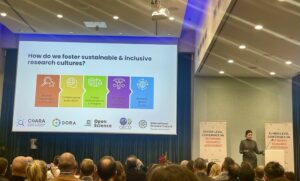
Former CoARA Steering Board member, Dr. Yensi Flores Bueso, presented a lightning talk on fostering a sustainable research culture and how persistent challenges of overreliance on narrow, indicator-drive assessment approaches continue to undervalue locally impactful work and diverse research profiles. She also presented key findings from a report that she co-authored earlier in 2025 called, “Regional and institutional trends in assessment for academic promotion.”

CoARA Vice Chair, Dr. Karen Stroobants, moderated the opening plenary on research assessment as a driver for change alongside Chair of the CeRRA Programme Committee of Aalborg University, Prof. David Budtz Pedersen. Discussions focused on how to embed proper incentives within the right infrastructures, changing definitions of excellence, how to further consider innovation in the reform movement, and the need for offering practical tools and enhanced collaboration to drive implementation. Expert panellists included Prof. Gemma Modinos, Cecilie Brøkner, Prof. Maria Leptin, Dr. Sonja Ochsenfeld-Repp, and Michael Arentoft.
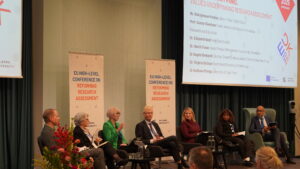
On the second day of the conference, CoARA Vice Chair, Dr. Elizabeth Gadd contributed as a panelist to the closing plenary on global values underpinning research assessment, alongside DORA Co-Chair, Prof. Virginia Barbour. Discussions focused on the relationship between data sovereignty and the impact of AI across different national systems, as well as the importance of fostering a values-based system for research that also drives national systems to cultivate mutual learning.
“Are we moving towards a system that is as aligned as possible and diverse as necessary or one that is as diverse as possible and aligned as necessary?”
Dr. Elizabeth Gadd, CoARA Vice Chair
Gadd’s interventions also highlighted CoARA’s 4th core commitment on the necessity to address how institutions engage with global university ranking systems that lack transparency and are often distorted by commercial incentives, noting that without addressing this core issue, research assessment will continue to be tied to publication-based metrics.
Discussions also centred around inclusivity, focusing on the need to acknowledge that who is not in the room is just as important as who is present, as noted by panellist Dr. Mfengu. Barbour built on this sentiment by adding that, “if the people who are impacted by a system aren’t part of the conversation, then the system won’t be effective.”
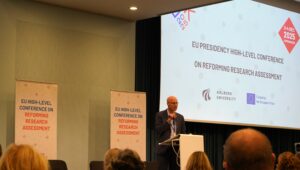
Closing remarks offered by Prof. David Budtz Pedersen, Michael Arentoft, Prof. Henk Kummeling, and Dr. Lidia Borrell-Damián distilled several overarching lessons from the two days of discussion, highlighting the importance of global platforms to facilitate collaboration.
Reflections clarified that the aim of CoARA’s mission for reform is not to impose uniform requirements but rather offer core principles and commitments to align values while allowing for different routes of implementation in respective reform journeys. This point also demonstrated the importance of contributing to the ERA Open Consultation which aims to shape a more robust EU research ecosystem.
Budtz Pederson stressed that collaboration must not be an afterthought but is instead fundamental to delivering public value in research systems, and that meaningful reform depends on shared ownership, sustained engagement, and most importantly, trust.
“We can only proceed at the pace of trust.”
Dr. Lidia Borrell-Damián
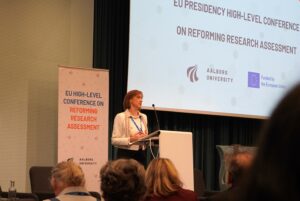
In the spirit of collaboration and community-building during DORA and CoARA side events that took place in Copenhagen, a joint-announcement solidifying an official commitment to shared progress between CoARA and DORA was released, which was echoed in Prof. Henk Kummeling’s final address.
“We will continue to work on further alignment with other important initiatives such as DORA, so that together we can push developments in the right direction even more firmly.”
Prof. Henk Kummeling, CoARA Chair
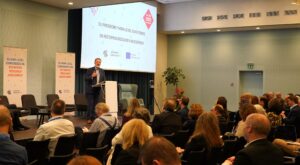
“We are working on a major cultural change, and it will never be finished. Science continues to evolve as long as we are critical, but for now, CoARA mainly wants to ensure that the glass with reform of research assessment becomes fuller than half full.”
Prof. Henk Kummeling, CoARA Chair
It is often difficult to feel progress and change while it is underway, however, as CoARA celebrates a key milestone on its third anniversary, marking the halfway point to 2027, the coalition must now focus on turning principles into practice, developing a precise definition of success, and providing tangible evidence to fill indicators and monitor progress.